
Foundations Built to Support Permanent Structures
Slab pouring in Peachtree City for garages, sheds, and additions where the base determines long-term performance
New subdivision lots in Peachtree City and Fairburn often need a properly formed slab for a detached garage, outbuilding, or home addition, and the quality of the base preparation decides whether the slab remains level or cracks and settles within a few years. Elite Contractors LLC pours concrete slabs for residential and commercial projects across Fayetteville and surrounding Georgia communities, handling excavation, base compaction, forming, and finishing. The slab is built to support the structure's load without movement, with reinforcement placed to control shrinkage cracking as the concrete cures.
The work begins with excavation to grade, removing topsoil and organic material to reach stable subgrade. Compacted base material is placed in lifts, and forms are set to level and secured to prevent shifting during the pour. Reinforcement is positioned, then concrete is poured, screeded flat, floated smooth, and finished to the planned texture before curing begins.
Arrange an on-site consultation to review grade conditions and base requirements.
What Changes After the Slab Cures
Base compaction is the step that separates a slab that holds its elevation from one that settles unevenly under load. The subgrade is compacted in controlled lifts using a plate compactor or roller, eliminating voids and ensuring uniform density across the entire footprint. Forms are checked for level and braced to prevent bowing when concrete is placed.
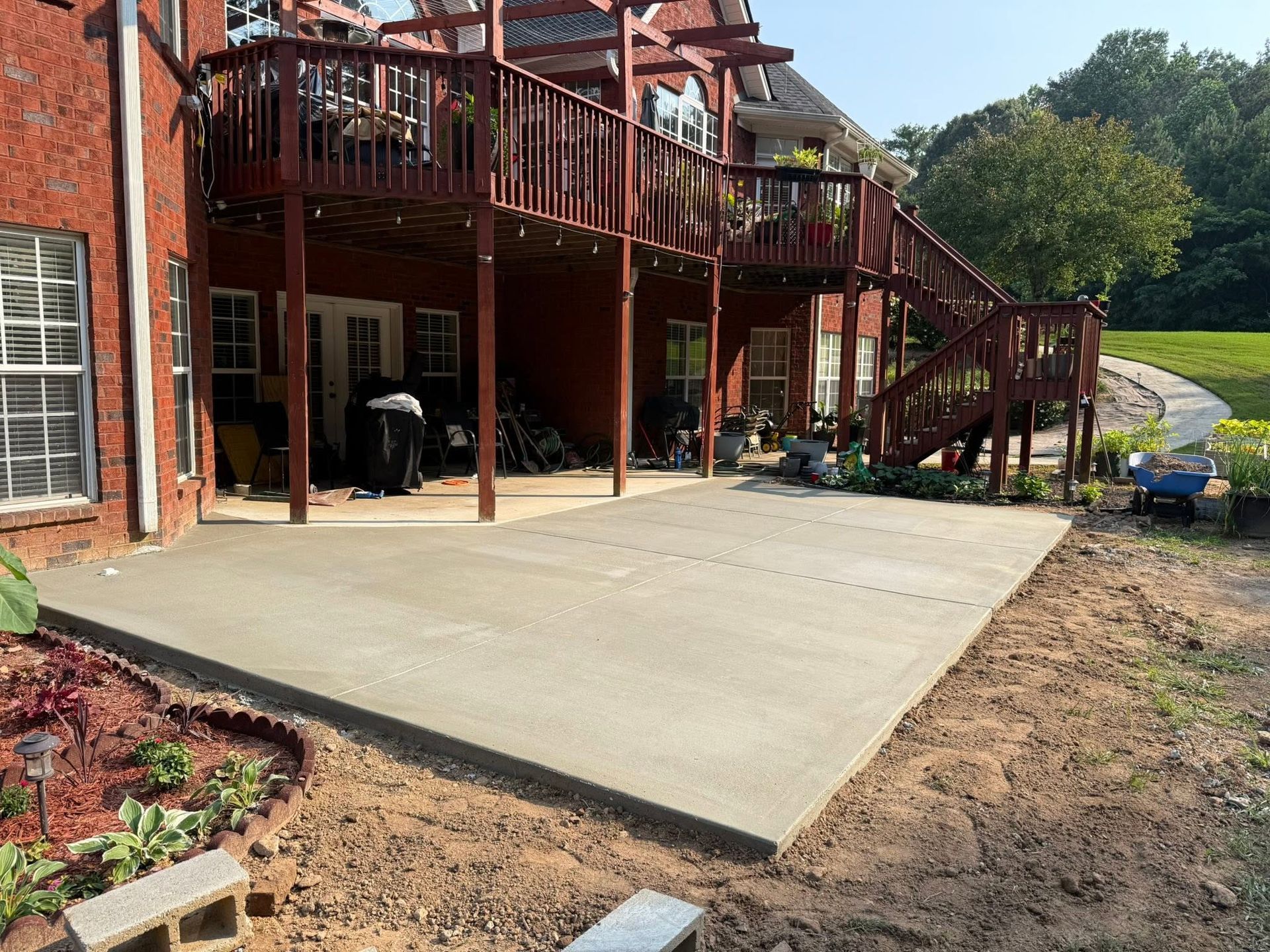
Once the slab cures, you have a flat, stable surface that supports walls, equipment, and vehicle loads without cracking or sinking. The finished slab remains at the elevation it was poured, with no differential settlement between corners or along the perimeter where fill was placed.
Confirm at your estimate whether the price covers base material, reinforcement, and finishing, as these are separate line items that affect both cost and durability. Slabs poured over recently placed fill require deeper excavation and additional compaction to prevent future settlement.
Common Questions About This Service
Slab work is a sequence of steps where each stage affects the next, and understanding what happens before the concrete arrives helps you evaluate whether the job is being done correctly.
What happens if the lot has recently been filled?
The crew excavates deeper to remove loose fill and reach undisturbed soil, then places and compacts structural fill in controlled lifts to create a stable base that will not settle under the slab's weight.
How is reinforcement positioned before the pour?
Steel rebar or welded wire mesh is supported on chairs or dobies that hold it at mid-thickness of the slab, ensuring the reinforcement is encased in concrete rather than sitting on the base.
Why is the surface floated and finished in stages?
Concrete is screeded level immediately after pouring, then floated once bleed water evaporates, and finally finished with a trowel or broom to create the final texture without trapping moisture beneath the surface.
What does proper curing involve for slabs in Peachtree City?
The slab is kept moist for at least seven days using curing compound, wet burlap, or plastic sheeting, which allows the concrete to reach full strength and reduces surface cracking from rapid drying.
How thick should a garage slab be?
Residential garage slabs are typically four to six inches thick depending on soil conditions and vehicle loads, with reinforcement sized to match the span and expected use.
Elite Contractors LLC also
pours concrete slabs in Newnan, Peachtree City, Tyrone, McDonough and Jonesboro. With over twenty years of hands-on slab work and a 5-star Google rating, Elite Contractors LLC offers free estimates on every project.