
Slabs Built to Handle Daily Traffic
Concrete driveways in Fayetteville for residential and commercial properties that need new construction, replacement, or widened approaches to match adjacent development
Concrete driveways are the core of the business at Elite Contractors LLC, which builds and replaces driveways for both residential and commercial properties in Fayetteville, Peachtree City, Tyrone, and nearby communities. Newer subdivision lots in Peachtree City and Tyrone often need driveway aprons and widened approaches poured to match the new construction next door, and the crew handles everything from initial grading through final finishing. You need this service when you're building on a new lot, replacing a cracked or settled driveway, or adding parking area to accommodate additional vehicles.
The process begins with a free estimate, followed by a timeline and scheduled service. The crew excavates to the correct depth, compacts the subgrade, adds base material where the soil conditions require it, and builds forms that establish the width, slope, and thickness of the finished driveway. Concrete is poured, leveled, and finished with control joints cut at intervals to manage cracking and a broom finish applied for traction. The driveway is cured and ready for use once the concrete has reached sufficient strength, typically within a week.
Arrange a free estimate to confirm the grading, base preparation, and timeline for your driveway project.
What Separates a Long-Lasting Driveway from a Problem Pour
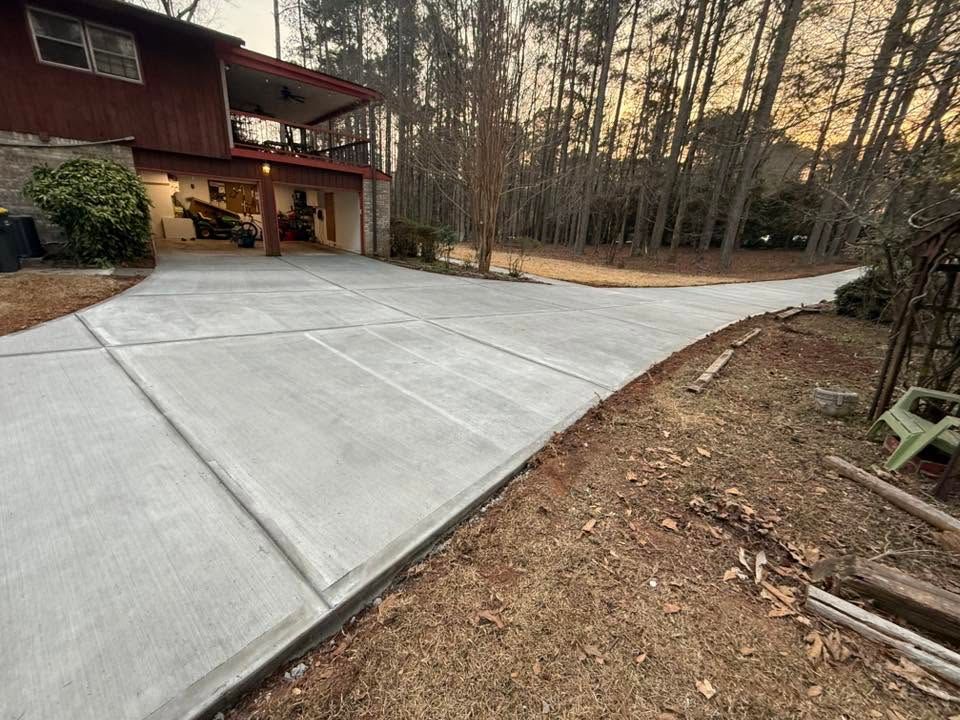
Driveways that last decades are built on stable subgrades with adequate base depth, proper thickness for the loads they'll carry, and control joints placed to manage cracking rather than prevent it. The subgrade is compacted to eliminate soft spots, and base material is added where the native soil drains poorly or compresses under load. Forms are set to the correct slope for drainage away from the garage and house, and reinforcement is placed where the driveway crosses soft areas or spans transitions between soil types. Concrete is poured to a thickness that handles vehicle weight without flexing, typically thicker than walkways or patios.
Once the driveway has cured, the surface drains correctly without pooling water near the garage or street, supports daily vehicle traffic without cracking at the edges or apron, and remains level across its width. Control joints appear as planned straight lines rather than random cracks, and the surface texture provides traction in wet conditions without being rough enough to damage tires or make snow removal difficult.
The work includes excavation, base preparation, formwork, pouring, finishing, joint cutting, and curing. It does not include removal of old driveways, grading beyond the driveway footprint, or utility relocation. Apron width, approach angles, and thickness are chosen based on the number of vehicles, turning radius, and whether commercial trucks will use the driveway.
Answers About How the Work Is Done
Property owners in Peachtree City and Tyrone frequently ask about the thickness and preparation required for driveways that will see regular use.
How thick does a residential driveway need to be?
Most residential driveways are poured four inches thick, which is sufficient for passenger vehicles and light trucks. Driveways that will carry heavier vehicles, such as delivery trucks or RVs, may be poured thicker or reinforced with rebar or fiber to prevent cracking under concentrated loads.
What is the purpose of control joints in a driveway?
Control joints are cut or tooled into the surface at regular intervals to create planned weak points where the concrete can crack as it shrinks and expands. Joints are placed perpendicular to the length of the driveway and spaced based on the slab thickness, typically every eight to ten feet. This prevents random cracking across the surface and keeps cracks aligned and manageable.
How is drainage managed on a driveway?
The driveway is sloped away from the garage and house to direct water toward the street, yard, or drainage features. The slope is built into the formwork and verified during pouring and finishing. Driveways should not have low spots where water can pool and freeze, which can lead to surface scaling and cracking over time.
What does the crew do if the soil is soft or poorly draining?
Soft or wet soil is excavated deeper, and additional gravel base is added to provide a stable platform that won't compress or settle under the weight of the concrete and vehicles. In some cases, the base is compacted in layers, with each layer tested before the next is added. Poor drainage may require subsurface drains or regrading to move water away from the driveway footprint.
What should the finished driveway look like?
The surface is level across its width with a consistent slope for drainage, and control joints are straight and evenly spaced. The broom finish provides traction without being overly rough, and the edges are clean and flush with adjacent surfaces. You should not see voids, uneven sections, or cracks outside of the control joints once the driveway has cured.
Elite Contractors LLC also builds concrete driveways in Peachtree City, Tyrone, Newnan, McDonough, and Jonesboro. Schedule a property evaluation to review the grading, base requirements, and approach design for your driveway.